Mostrando las entradas con la etiqueta typewriters. Mostrar todas las entradas

17 de agosto de 2014

Anno 1914 - Guest post by maschinengeschrieben

We are happy to publish a guest post by Florian of maschinengeschrieben. Thank you Florian, and long live the Swiss typosphere!


25 de noviembre de 2013

Typewriters in the House of History Bonn

I took the occasion of my stay in Bonn, former capital of the Federal Republic of Germany, to visit the "Haus der Geschichte", i.e. "House of the History of the FRG". The project of a museum dedicated to German history after 1945 had been in the pipeline since the 1980s, and was opened - already after the unification - in 1994. As a trained historian, I was curious how the Germans would go ahead with the task of displaying and reflecting their history. I must say, I was more than pleasantly surprised. The permanent exhibition follows a chronological trail stuffed, but not overburdened, with facts, but especially artifacts, historical and daily life objects which make history "begreifbar", visible and comprehensible.

Wouldn't there be any typewriters on display??

*** SPOILER ALERT: YES THERE WERE! ***

"Salonwagen 10 205", the special (State) train, originally constructed for Hermann Göring in Nazi-Germany in 1937 (then numbered Sal 4ü-37), used after WWII by the Western Germany's top ranking officials, namely chancellors Konrad Adenauer, Ludwig Erhard, Kurt Georg Kiesinger and Willy Brandt.

Here we see the typewriter displayed in the compartment of the Sonderzug 10 205. It is a Triumph standard machine. I couldn't give it some closer inspection, unfortunately, but according to me, this is a Triumph Matura, in its "Super" variant provided with a special paper inserting lever (cf. Dingwerth, Lexikon, p. 572)

The Triumph Matura models were produced between 1950 and 1960. 

Moving closer into the permanent exhibition, we are now in the period immediately after 1945. This Seidel & Naumann IDEAL typewriter is displayed in the context of efforts to organize life in the close to chaotic circumstances following 1945, with hundreds of thousands of Germans fleeing from the East, needing shelter, and hundreds of thousands of people looking for their family members which were lost in the turmoils of war and the immediate post-war. The German Red Cross for example established a search service, filling file after file, and often on typewriters, when available.

Here we look at the Eastern zone of Germany, the Soviet-occupied territory which would become the German Democratic Republic in 1949.  Many companies located in the Eastern zone are nationalized after 1945, they become "the people's property" (VEB = Volkseigener Betrieb).  This is also the case of many well-known typewriter companies, as the majority had their seats and plants in the East. Here we see the example of a Wanderer Continental typewriter, now "VEB Büromaschinenwerk Wanderer-Continental".


The Erika line of typewriters goes back to 1910. At the time of production of this Erika No. 8, the company, now state-owned, was called "Mechanik vorm. Seidel & Naumann VEB Dresden". Model 8 was produced from 1949 to 1952. I do have a model 9 in my collection. The picture recalls and raises our consciousness as to the political circumstances of the production period: here we see comrade Stalin being congratulated and honoured on the occasion of his 70th birthday in 1949. You see how aptly the House of History puts together objects, with immediate effect of awareness-rising.


Stalin, Erika


Here is the machine of Theodor Heuss (1884 - 1963), first President of the Federal Republic of Germany from 1949 to 1959. It is aptly described as "indispensable tool of a successful writer and publicist". Heuss had been a writer in his own right and had worked as a political journalist. This Groma Model N was labelled as produced in 1941.

Another prominent typewriter on display is this Klein-Adler 2 having belonged to the renowned physicist and philosopher Carl Friedrich von Weizsäcker (1912 - 2007).  On Nov. 19th, 1956, he and 17 other leading nuclear researchers wrote a letter (on this very machine) addressed to the secretary of defense of the FRG, strongly opposing the government's plan to arm the Bundeswehr with tactical nuclear weapons. This initiative became known as the "Göttingen manifesto".


We are in the Wirtschaftswunder times, and German exports are growing. Amongst them, calculating machines and typewriters. Here we see an Olympia SG1 in its crate, and ready for shipping.


One nice Adler poster to conclude our visit.
To be continued after my next visit to the museum - it was so large that I only made it into the 1950s.

10 de noviembre de 2013

Typewriters are long gone

Typewriters are long gone - Celebrating 50 videos © typewriters.ch

The somewhat misleading title "Schreibmaschinen sind längst vorbei / Typewriters are long gone" is the title of the 50th video published under the typewriters.ch brand. Typewriters are obsolete - long live the typewriter!


IBM Electric IBM Electric IBM Electric IBM Electric

20 de mayo de 2013

Typewriter exhibition in Switzerland

This was great, and great fun! My friend Mark and i organized an exhibition at the Swiss SHBS International meeting in Appenzell, Switzerland. The topic was ... Swiss Typewriters! Focus was on smaller brands like Patria/ Swissa (Swiss branch of the Patria family) and Calanda, but also for example featuring Otto Petermann, of Swiss origin and creator of the Corona portable. We were able to present 7 models of "RUF" accounting machines as well. Quite a few people came to see the show, actually. Here is some impressions:


7 de mayo de 2013

Some RUF

Ruf book-keeping system. Named after Alfons Ruf (1887 - 1931). Swiss.
Farbbanddose RUF
Ribbon tin (made of plastic)
Ruf portable typewriter
early Ruf # 39501, built 1937
Ruf Hermes 193512xx 020 NZZ
1935 ad: "Swiss! / Ruf portable / The only Swiss made portable accounting machine , it equally serves for regular correspondence. Commendable in every respect. Do you wish for a brochure, presentation, sample order? / Ruf Buchhaltung Aktiengesellschaft (Ruf Accounting Inc.)" 
Ruf logo 1937
detail logo from above
Ruf typewriter
# 385764 (made in 1942)
Ruf Hermes 195012xx 022 copy Basler Nachrichten
1950 ad
RUF Electric
one more green giant.
RUF Electric

21 de enero de 2013

Negozio Olivetti in Venice

Here is a must for Olivetti fans: the "Negozio Olivetti" ("Olivetti shop") in the very heart of Venice. Design: Carlo Scarpa.
go see it here:
http://www.negoziolivetti.it/
plus some photos:
http://my.momapix.com/mesmith/#search/olivetti
next time in Venice, hopefully soon...

28 de diciembre de 2012

A Wonderful Day at Hermes Welten

Hermes Welten (literally, "Hermes Worlds") is an office supplies specialist shop in Basel. For those collecting Hermes typewriters, the name might sound familiar. I had seen many stickers on old typewriters from the 1950s and 1960s bearing the "Hermes im Drachen" (literally, "Hermes in the [house of the] Dragon") label. It turns out that this company is still in business after all these decades, and even at the same location in Basel's Aeschenvorstadt 24.

Me being in Basel and this being such a traditional company was reason enough to go pay them a visit around christmas. Here is what I found (s. photos below). My thanks go to Mr. Bloch and his team, who welcomed me and took quite some time going through their machines in detail. It turned out that the company had amassed quite a good collection of typewriters as they went along in their business. Some machines, e.g., still bore the original tag from when they arrived and were incorporated / shelved in the collection. Very nice discoveries and a typewriter day well spent!

Hermes Welten will service your manual and other typewriters, find the right ribbons for you, etc. The address is:
Hermes Welten AG
CH- 4010 Basel
Aeschenvorstadt 24
im Drachen, 2. Stock
www.hermes-welten.ch

Christmas ambiance

What a nice shelf! Erika folding, Japy, Hermes and what I believe to be a Smith in sight.

Erika n° 4248


A Japy 3Y in excellent state. Serial number 3925. I got one of those and will produce a detailed report asap. This machine is a direct descendant of the Rem-Sho / Fay-Sho / Remington-Sholes line, tools and design were sold from the U.S. to France around 1909 when the American business shut down.


This Hermes No. 3 had collected quite some dust, but would still perform. It is an unusual specimen as the paper tray seems to be taken from the Hermes No. 2 line. Could it be that it was still used with early No. 3s? Cf. Will's summary here.

Bingo! One of the rather rare Hermes No. 2s. This one is serial number 1275.


A portable from the wunderbar Royal line. I recently discovered the excellent type-feeling of these little gems. Here is serial number C-1740432.


Erika 8 in beautiful condition. # 1189634 and already made in Eastern Germany - although on the back it only says "Made in Germany". What is common to the Erika line is the incredibly light touch. Then, the various models do differ, and the type feeling of the pre-war machines is quite different from say this one.


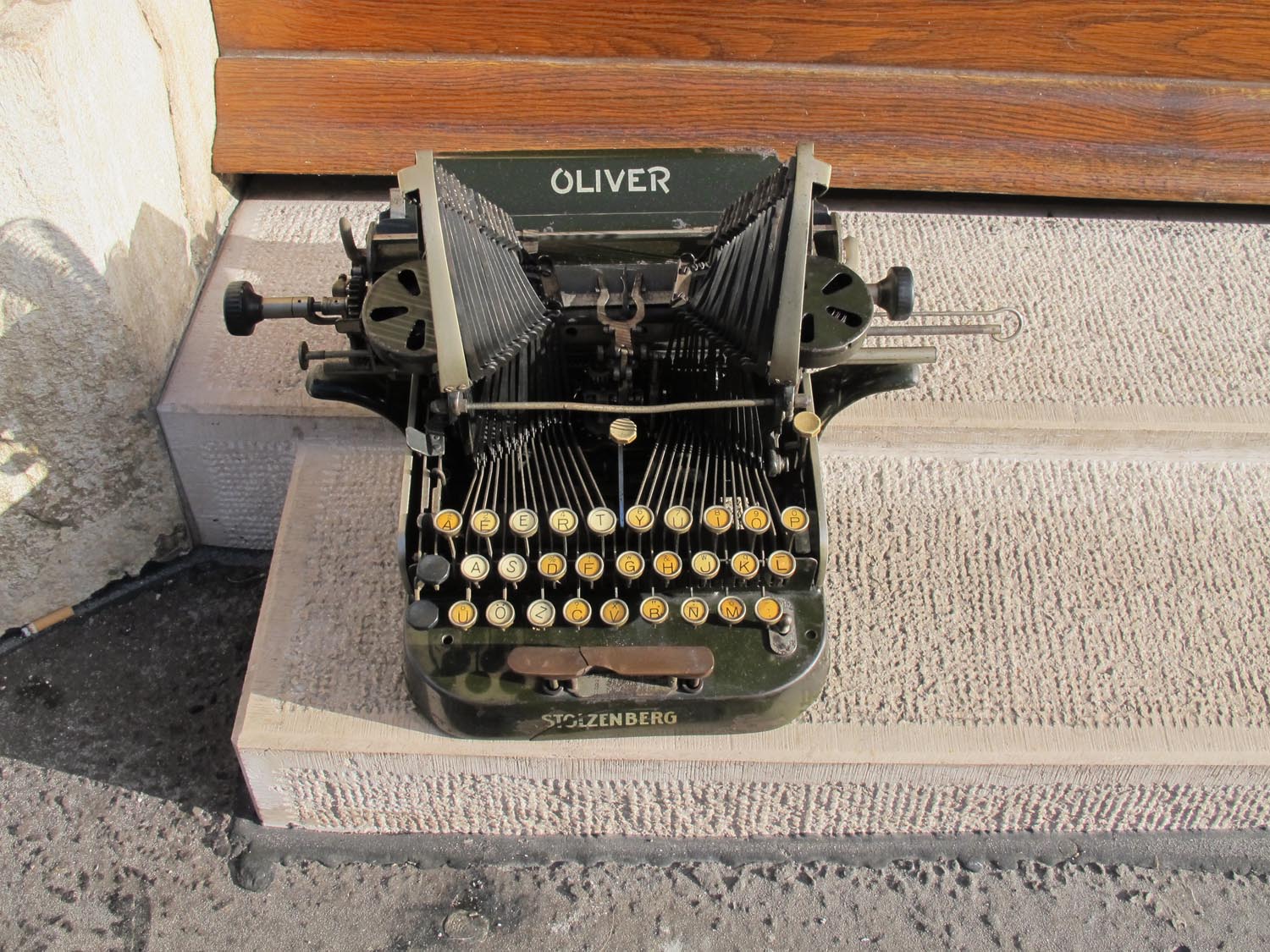
Oliver, distributed in Germany by the Stolzenberg company. # 125543.

Can you believe this beautiful NOISELESS? As recently seen in a shop in the Swiss Jura region, the general agents for Switzerland were "Kaden & Co." in Basel. Not uncommon for the time, this information is printed on the machine in English.


This nicely preserved MIGNON No. 3 with serial number 77340 also bears the labels AEG (Allgemeine Electrizitäts-Gesellschaft, the producer) and, less common, USG. This stands for Union Schreibmaschinen-Gesellschaft, which was the company established by AEG for distribution of the Mignon.


The "Christmas shelf" with a few selected beautiful machines.

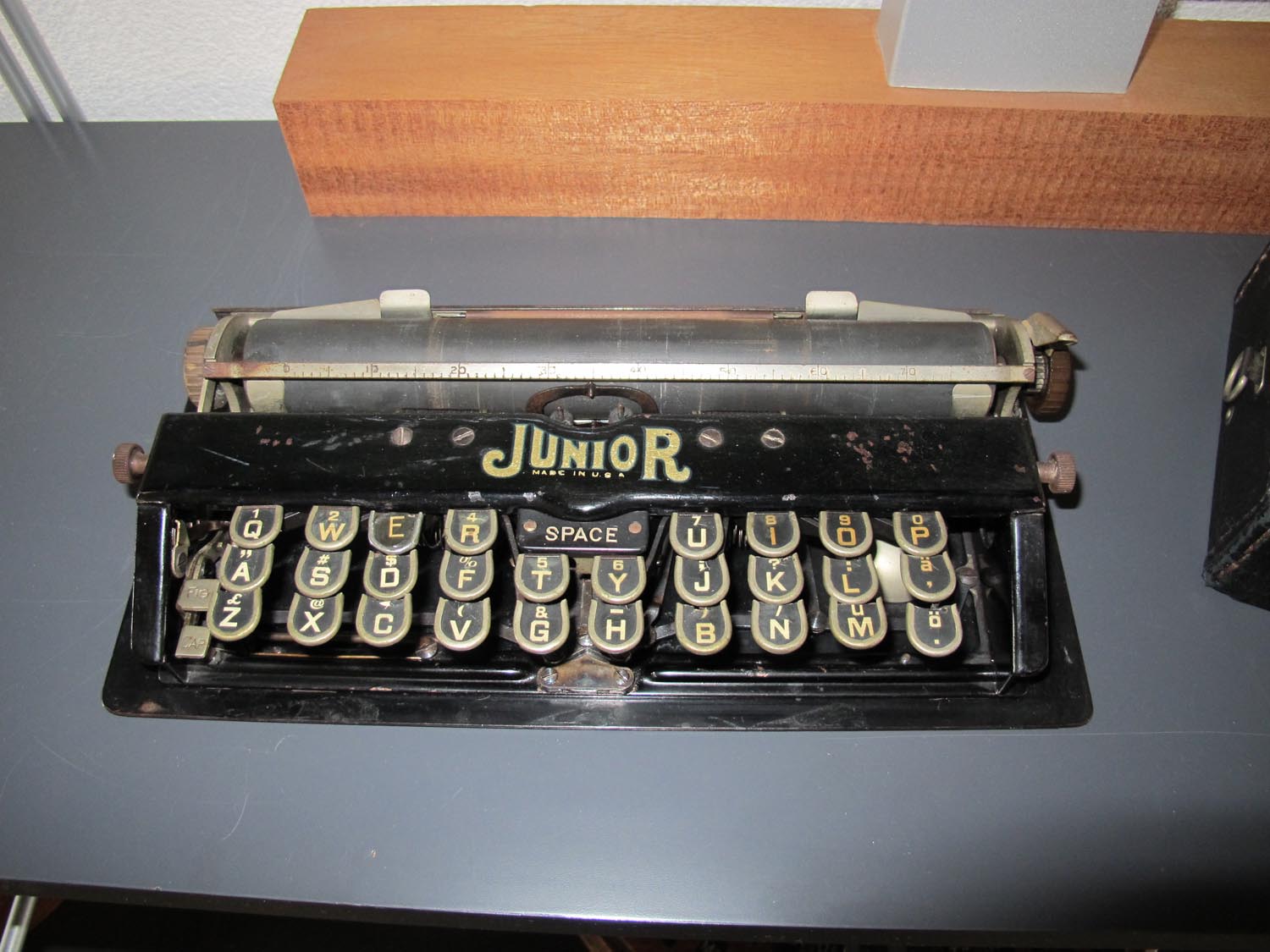
The Junior, aka Bennett.

Hammond! Always a highlight for every collector.


A view of the keyboard layout.

An early and beautifully preserved Hermes 2000. You can see it is an early one as the usual Hermes 2000 attributes suc h as automatic tab-setting lever on the left side above the back space key is missing, so is the spring tension regulator on the back (not shown on the pictures). # 26135.


The cross-bow, logo of Swiss quality products as applied from the 1930s on. 

I bade farewell to my hosts at Hermes Welten, but the Oliver Stolzenberg followed me on the street. I took this as a sign and offered her a new home.