Sommeregger's Sammelsurium feels very much obliged to respond to typospherians' requests. As suggested by Richard, here is a quick overview of the electric toy typewriter I took home from Cologne. It is the Electric 600 model produced by Jolux. I am still searching for information on this company. Working hypothesis is that it is a French company, and that the name would derive from "jouets" (toys) and "luxe"? TO BE ASCERTAINED. Until then, some evidence of this rather original construct:

Mostrando las entradas con la etiqueta machine à écrire. Mostrar todas las entradas
Mostrando las entradas con la etiqueta machine à écrire. Mostrar todas las entradas
22 de noviembre de 2013
5 de octubre de 2012
7 de enero de 2012
Stella - a lonely star on typewriter heaven

Last time we talked about Octave Rochefort's "Dactyle" typewriter. A friend just mailed me the copy of a Dactlye advertising booklet from around 1900 (the company was founded ca. 1893, and in the booklet they claim that in the past eight years, they had sold 8.000 Dactyle typewriters in France alone).
Interesting enough, the Dactyle company at that time not only sold Dactyle typewriters model 2 and 3 (equivalent to the Blickensderfer models 5 and 8), but also a typewriter called "Stella".
The ad shown below is pretty detailed and features a good photo and thorough description of what seems to be a hybridation between the Dactyle n°2 and an index machine. Bear in mind that "Stella" cost only 100 francs, as compared to 250 for a Dactyle n°2. The ad starts off admitting that "Stella" might be a good deal slower than the Dactyles. However, on the whole it would perform well, as this would be the only disadvantage. The print would be impeccable and it could manage up to 10 carbon copies easily.
Stella would use the same type wheel and carriage as the Dactyle. But then, the print was not done by keys, but in two movements using first the type wheel to choose the letter, then push to print it.
As all the other products in the Dactyle catalogue are licensed and not own developments, I supposed that also the "Stella" might be a re-brand of an original developed elsewhere. Et voilà, thanks to a mental spark connecting the right synapses, combined with information from Chuck & Rich's Antique Typewriter website and museum I could find it: NIAGARA!
According to the information given by Rich & Chuck, these are pretty rare machines, so watch out for next time it crosses your path. At that moment, flip your wallet open and smile.
Some more information: - sales price was 15 dollars in the U.S., 70 RM in Germany, and as already mentioned 100 French francs. Ernst Martin p.192 reports that the first year of production of the Niagara was 1902 (so probably the brochure presented here dates from shortly after 1902). Although sales seem to have been low, it was produced at least past 1909, when - again according to Martin - Blickensderfer introduced a Hebrew version of this machine.
- The highest serial number I could find (Niagara) is 300 (Finnish typewriter museum).
- One more name variant: a Niagara labeled "Best" is mentioned in Historische Bürowelt n°1, 1982.
 |
| © Au fil de la plume, n°85 |
 |
| © Au fil de la plume, n°85 |
 |
| © typewriter.rydia.net |
Some more information: - sales price was 15 dollars in the U.S., 70 RM in Germany, and as already mentioned 100 French francs. Ernst Martin p.192 reports that the first year of production of the Niagara was 1902 (so probably the brochure presented here dates from shortly after 1902). Although sales seem to have been low, it was produced at least past 1909, when - again according to Martin - Blickensderfer introduced a Hebrew version of this machine.
- The highest serial number I could find (Niagara) is 300 (Finnish typewriter museum).
- One more name variant: a Niagara labeled "Best" is mentioned in Historische Bürowelt n°1, 1982.

 Labels:
Blickensderfer,
Dactyle,
index,
machine à écrire,
Niagara,
Stella,
typewriter
Labels:
Blickensderfer,
Dactyle,
index,
machine à écrire,
Niagara,
Stella,
typewriter
6 de enero de 2012
Did Pétain type on this one?
Now here is something unusual, and as a historian I hope I don't fall into utter speculation with the following story. Maybe it is too good to be true, but who knows?
It started with this wooden box I received in the mail (admittedly, I knew there was a typewriter inside, but still there is always a certain thrill about opening the case, especially around Christmas).
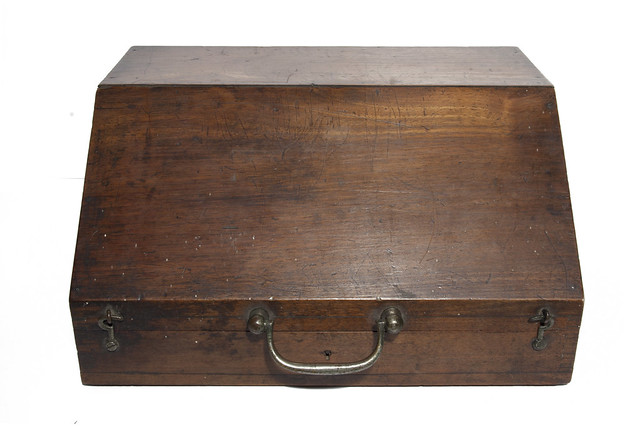
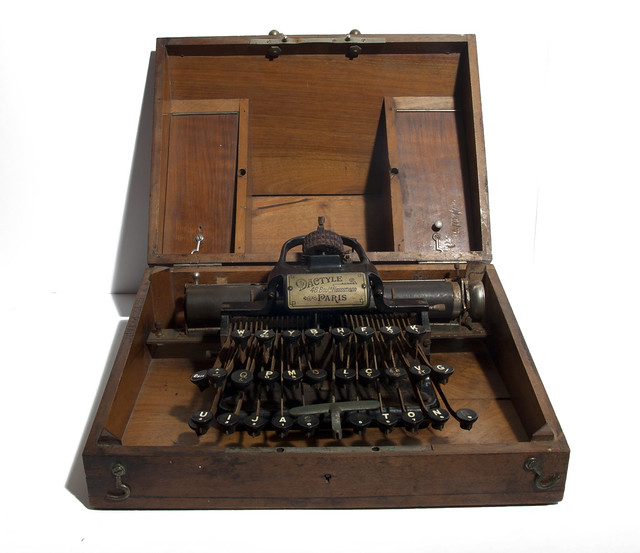
Dactyle, from France - very nice!!!
Manufactured in its first year of production, which was around 1895 (serial number 49!!).
 But what about the inscription found on the left side of the case?

Now please help me to think this a bit further. Henri Philippe Benoni Omer Joseph Pétain (1856 - 1951), called Philippe Pétain, was a French military. Not any French military. Seen as hero because of his deeds in World War I, he entered politics around 1930 and became the head of Vichy France in World War II. He was already 84 years old when he assumed power in 1940. Too bad, because in the following years he awfully spoiled his reputation by collaborating thoroughly with the Germans, which cost thousands of people's lives.
After the war, he was tried for treason, sentenced to death - later on commuted to life sentence - and spent his last years in exile on a small island.
Now, why would this charming machine have belonged to Maréchal Philippe Pétain?
 Here is my proposal:
In order to find out whether this typewriter could have belonged to "the" Pétain, we have to take the following elements into consideration and under scrutiny: the name inscription, and time and circumstances of use. From the previous owner I could by the way get no information other than he himself had found this typewriter on a Swiss market. So let's see:
The inscription is "Gl * P * PETAIN". "P" and "Pétain" would obviously fit, knowing that he was addressed as "Philippe", rather than with his real first name "Henri".
 This is my "G" with superscript "l". Your opinion, please. I tried to find out whether there was a fixed code of abbreviations of military ranks for the French army in the early 20th century. It appears that at the time, there were no uniform rules on the topic. So "Gl" might well mean "Général".
 Now, obviously, by World War II this typewriter would have been hopelessly outdated, but my assumption is that during World War I, Dactyle typewriters also of the first generation - as is the specimen in question - were still in use. Those were very functional and light portable machines and certainly came in handy in the field. I could not find many reports about Blicks in the field, but it is well known from Corona 3s that they were widely used in the armies. So, I would contend that this model could have been in use by French military in World War I.
 But would the rank and the time coincide? Pétain is better known as Marshal of France, but this was a later title. On the eve of World War I, surprisingly enough, and Pétain being already in his late fifies, he still had not been promoted general. He had fallen out with his superiors on a question of military tactics, which explains. So he was close of taking his pension, when in 1914 the war broke out. He distinguished himself in a first battle, and was promoted General on 31st August 1914.

So, we have a name tag on the typewriter's case which would fit the General, also a fitting time-frame and circumstances likely to support the hypothesis that this machine was indeed General Pétain's. Now, your opinions please!
Read more on the Dactyle and its fascinating promotor Octave Rochefort on typewriters.ch.
P.S.: You might wonder about the hand with the star of David - this emblem is to be found on every Dactyle typewriter, it was put there by the manufacturer. Reason still unknown. The hand is a so-called "Hamsa", supposedly with apotropaic effect, and popular in both Islam and Judaism. Here it is combined with the Magen David, or Star of David.
It started with this wooden box I received in the mail (admittedly, I knew there was a typewriter inside, but still there is always a certain thrill about opening the case, especially around Christmas).
Dactyle, from France - very nice!!!
Manufactured in its first year of production, which was around 1895 (serial number 49!!).


I read "Gl * P * PETAIN"
 |
| source: wikimedia commons, Bundesarchiv Bild 183-H25217 |
Now, why would this charming machine have belonged to Maréchal Philippe Pétain?

In order to find out whether this typewriter could have belonged to "the" Pétain, we have to take the following elements into consideration and under scrutiny: the name inscription, and time and circumstances of use. From the previous owner I could by the way get no information other than he himself had found this typewriter on a Swiss market. So let's see:
The inscription is "Gl * P * PETAIN". "P" and "Pétain" would obviously fit, knowing that he was addressed as "Philippe", rather than with his real first name "Henri".


So, we have a name tag on the typewriter's case which would fit the General, also a fitting time-frame and circumstances likely to support the hypothesis that this machine was indeed General Pétain's. Now, your opinions please!
Read more on the Dactyle and its fascinating promotor Octave Rochefort on typewriters.ch.
P.S.: You might wonder about the hand with the star of David - this emblem is to be found on every Dactyle typewriter, it was put there by the manufacturer. Reason still unknown. The hand is a so-called "Hamsa", supposedly with apotropaic effect, and popular in both Islam and Judaism. Here it is combined with the Magen David, or Star of David.
Labels:
Dactyle,
machine à écrire,
Octave Rochefort,
Pétain,
Schreibmaschine,
typewriter
13 de noviembre de 2011
Gabriele and her twin sisters
There was a young woman, Gabriele by name. She called upon each customer to trust her. But she had three sisters, too. One was "Junior", one was "Mädchen", and the youngest one "J2".
And here is the corresponding booklet covers:


Any more sister sightings? Thanks for reporting.
 |
| Gabriele 10 20 30 |
 |
| Adler Junior 10 20 30 |
 |
| Scheidegger Typomatic-TMS |
 |
| Adler J2 / J4. Picture via machinesoflovinggrace |


 |
| Picture via machinesoflovinggrace |
4 de noviembre de 2009
11 de agosto de 2009
"Oliver" portable typewriter

OLIVER PORTABLE TYPEWRITER
model: ?
manufacturer: ?
serial number: 104896
year of production: ? (probably 1930s)
keyboard: QUERTZ / French (Swiss-French?)
"Oliver" typewriters are most commonly associatiated with the popular Oliver standard typewriter, which stands out by its "winged" shape (see the Wikipedia entry for more information on the Oliver Typewriter Company). The history of Oliver portable typewriters is somewhat complicated: the British Oliver Typewriters Ltd.'s portable typewriters were duplicated by several other firms (1). According to information available at Will Davis' website (1), the machine featured here would fall "into the family loosely known as the 'SIM / MAS' group of portables, made in Italy and which carried a wide variety of names and models over a number of years."
Special features:
1. The serial number 104896 is not a mechanical engraving as usually, but engraved by hand.

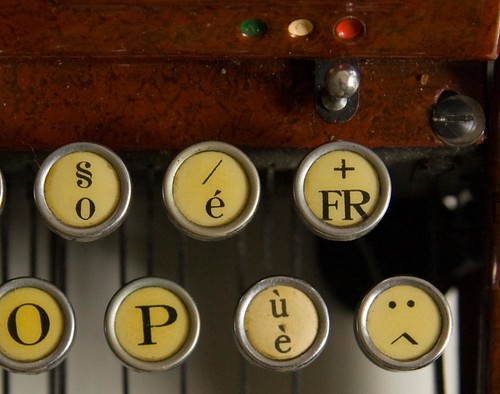
2. There is an extra "FR" currency key for (French or Swiss) francs. The ribbon selector in the colours green - white - red might reflect the Italian flag, where the typewriter was probably produced. Incidental gimmick: can you see the keyboard's "smiley"?
(1) Will Davis, OLIVER portables and relatives, http://www.geocities.com/wbd641/oliver.html (visited 2009-08-11)
last update: 8.3.2010
8 de agosto de 2009
Triumph Klein-Schreibmaschine
Triumph Klein-Schreibmaschine "Modell 1" oder "Klein-Triumph"
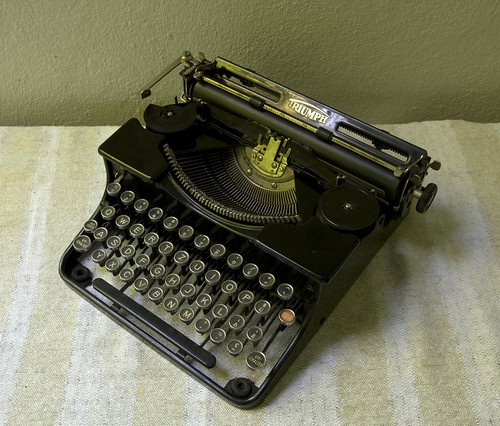
Triumph portable typewriter. More photos here.
Modell: Modell 1 oder Klein-Triumph. Modell ab 1928 hergestellt. (1)
Hersteller: Triumph-Werke Nürnberg AG
Seriennummer: 314636
Herstellungsjahr: 1940 (?)
Tastatur: Schweizer-Deutsche Tastatur
als Geschenk erhalten in Courtedoux im August 2009.
Ab 1928 stellten die Triumph-Werke ihre erste Klein-Schreibmaschine her. Sie war von eigenen Mitarbeitern konstruiert worden und erhielt die Bezeichnung "Modell 1" oder "Klein-Triumph" (1, S.23). Wir sehen sie auf diesem Werbeplakat:

source: von Zezschwitz Kunst und Design
Fussnoten:
(1) Leonhard Dingwerth, Die Geschichte der Deutschen Schreibmaschinenfabriken- Band 1: große und mittlere Hersteller, BoD – Books on Demand, 2008 (ISBN 3921913381, 9783921913383).
last update: 8.3.2010
Triumph portable typewriter. More photos here.
Modell: Modell 1 oder Klein-Triumph. Modell ab 1928 hergestellt. (1)
Hersteller: Triumph-Werke Nürnberg AG
Seriennummer: 314636
Herstellungsjahr: 1940 (?)
Tastatur: Schweizer-Deutsche Tastatur
als Geschenk erhalten in Courtedoux im August 2009.
Ab 1928 stellten die Triumph-Werke ihre erste Klein-Schreibmaschine her. Sie war von eigenen Mitarbeitern konstruiert worden und erhielt die Bezeichnung "Modell 1" oder "Klein-Triumph" (1, S.23). Wir sehen sie auf diesem Werbeplakat:

source: von Zezschwitz Kunst und Design
Fussnoten:
(1) Leonhard Dingwerth, Die Geschichte der Deutschen Schreibmaschinenfabriken- Band 1: große und mittlere Hersteller, BoD – Books on Demand, 2008 (ISBN 3921913381, 9783921913383).
last update: 8.3.2010
5 de julio de 2009
Continental typewriter, X-large
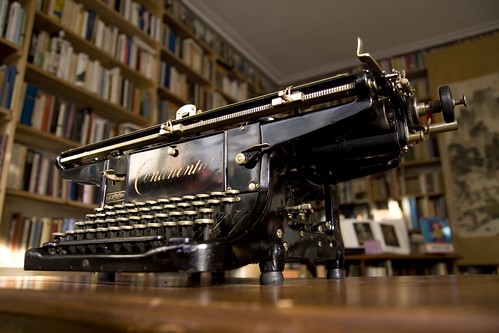
If you have more information on this exact model, please contact me (see "contact" on top of this blog).
| Factsheet | Continental Standard |
|---|---|
| Manufacturer | Wanderer Werke AG,formely Winklhofer&Jaenicke, Sigmar-Schönau, Germany. |
| Model | Continental Standard (wide carriage) |
| Serial number | 440166 (produced in 1930) |
| Special features | Swiss-German keyboard; long carriage (ca.16 inches) |
| Originally sold by | "J.F. Pfeiffer, Basel" |
This machine comes from a private sale near Basel in July 2009, independent from our recent other Continental Standard typewriter, which we bought in a second hand shop. However, both typewriters were originally sold in the same shop, "J.F. Pfeiffer, Basel", and also stem from the same period, as can be deducted from the closeness of the serial numbers.
This typewriter cost 50 CHF and came in ok, but not neat condition. A bit of dusting and oiling, as usually, did the job, it now writes very neatly, and I can assure you it's good finger training to type on it!

The serial number is 440166, which, according to the Typewriter Serial Number Database would fall in the production year 1930.
last update: 8.3.2010
29 de junio de 2009
Continental typewriter
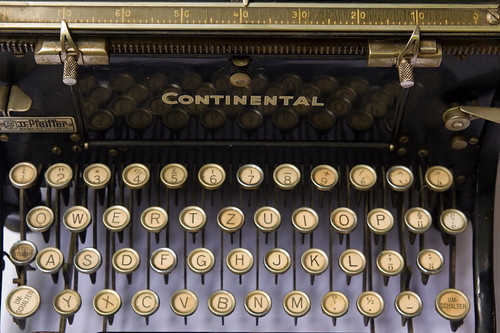
The new member of my collection - Continental Standard, welcome!
Factsheet:
Model: Continental Standard
Manufacturer: Wanderer-Werke, formerly Winklhofer&Jaenicke, Sigmar-Schönau, Germany.
Special features: Swiss-German keyboard
Serial number: 438669 (manufactured in 1930)
Weight: heavy!
We bought this nice typewriter for 65 Swiss Franks at Heilsarmee Brockenstube (a second hand shop) in Basel, Switzerland. A little plate reading "J.F.Pfeiffer, Basel", and which is attached to the front display, indicates that the typewriter was also originally sold in Basel. From the serial number 438669 we can deduct it was manufactured in 1930 (cf. the Typewriter Serial Number Database). The keyboard layout is Swiss, which means it features all Umlaut needed for German, but also the complete French accents.
The Continental came not in neat, but in ok condition. You could see it had been stored in some forgotten dusty place for decades. The carriage and some keys wouldn't move properly at first trial. A bit of dust cleaning and oil on carriage and the type mechanism, however, did the trick and restored the basic functions, i.e., we could type our first letter within a day.
The first Continental typewriter was built in 1904. Its design remained very much unchanged over the years of production (2, at p.53). The Wanderer Continental was probably the most sold German typewriter of its time (2, at p.53).
Literature:
(1) Leonhard Dingwerth, Die Geschichte der Deutschen Schreibmaschinenfabriken- Band 1: große und mittlere Hersteller, BoD – Books on Demand, 2008 (ISBN 3921913381, 9783921913383).
(2) Leonhard Dingwerth, Historische Schreibmaschinen: Geschichte, Technik und Faszination. Sammlerträume, Verlage Battenberg und Gietl, 2008 (ISBN 3866460414, 9783866460416).
last update: 8.3.2010

Factsheet:
Model: Continental Standard
Manufacturer: Wanderer-Werke, formerly Winklhofer&Jaenicke, Sigmar-Schönau, Germany.
Special features: Swiss-German keyboard
Serial number: 438669 (manufactured in 1930)
Weight: heavy!
We bought this nice typewriter for 65 Swiss Franks at Heilsarmee Brockenstube (a second hand shop) in Basel, Switzerland. A little plate reading "J.F.Pfeiffer, Basel", and which is attached to the front display, indicates that the typewriter was also originally sold in Basel. From the serial number 438669 we can deduct it was manufactured in 1930 (cf. the Typewriter Serial Number Database). The keyboard layout is Swiss, which means it features all Umlaut needed for German, but also the complete French accents.
The Continental came not in neat, but in ok condition. You could see it had been stored in some forgotten dusty place for decades. The carriage and some keys wouldn't move properly at first trial. A bit of dust cleaning and oil on carriage and the type mechanism, however, did the trick and restored the basic functions, i.e., we could type our first letter within a day.
The first Continental typewriter was built in 1904. Its design remained very much unchanged over the years of production (2, at p.53). The Wanderer Continental was probably the most sold German typewriter of its time (2, at p.53).
Literature:
(1) Leonhard Dingwerth, Die Geschichte der Deutschen Schreibmaschinenfabriken- Band 1: große und mittlere Hersteller, BoD – Books on Demand, 2008 (ISBN 3921913381, 9783921913383).
(2) Leonhard Dingwerth, Historische Schreibmaschinen: Geschichte, Technik und Faszination. Sammlerträume, Verlage Battenberg und Gietl, 2008 (ISBN 3866460414, 9783866460416).
last update: 8.3.2010
13 de marzo de 2009
Remington Portable #2
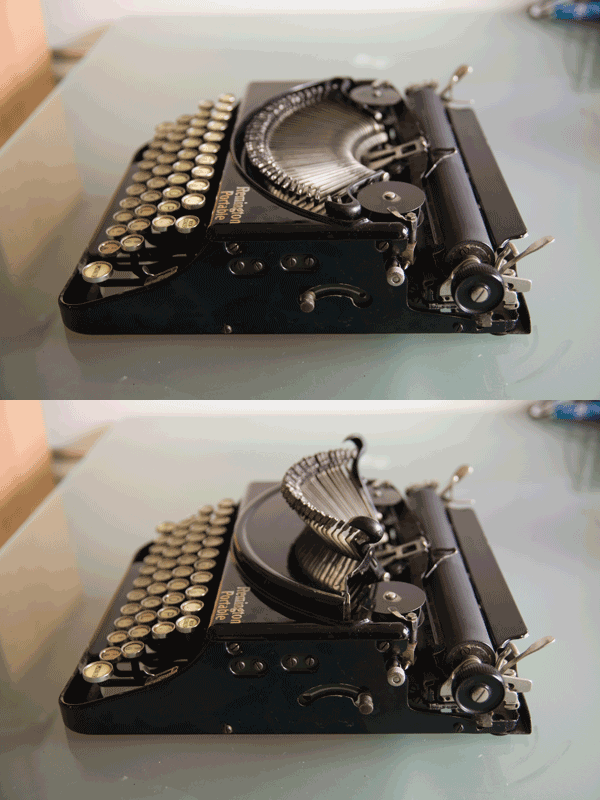
Fact sheet:
Manufacturer: Remington Rand
Model: Remington Portable #2
Serial number: V150477
Keyboard: German
Purchased in Basel, Switzerland, in Autumn 2008.
This Remington Portable has a rather small font, a lovely feature - you can fit many words, tighly written, in one page.
When was it made? Usually, a typewriter is easy to date with the help of the Typewriter Serial Number Database. This time, however, we cannot be so sure. According to Richard Polt's Remington Portables' page, #2 production started in February 1925, SN V131518 was made in December 1928. Our #2 with the SN V150477 is thus post-1928 produced. Should you have any information which would allow for more precise dating (such as - ideally - original manufacturer's lists), please share them with us!
12 de marzo de 2009
Triumph Durabel typewriter
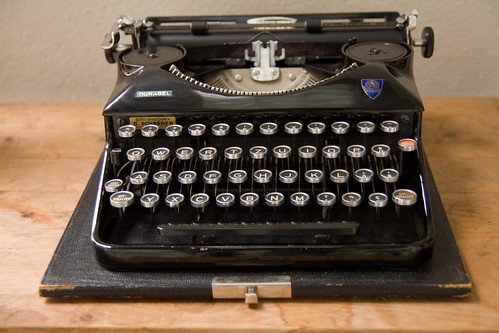
Fact sheet
model: Triumph Durabel
serial number: 328300 (manufactured in 1940)
keyboard layout: Swiss-German
complete with original case
purchased in Switzerland in March 2009 for 38 CHF
The serial number 328300 would indicate the production year 1940 (source: the typewriter database at http://www.tw-db.com/). Next to the "DURABEL" sticker and the insignia of the Triumph company, the label of Schreibmaschinen G. Schaerer Basel (a typewriter shop) is also still on.
Particularities
It writes with ease and has a beautiful font. According to http://www.100besteschriften.de/
(itself quoting from the book Made with Fontfont) Erik van Blokland's modern Trixie font of 1991 is based on the Triumph Durabel's font.
last update: 8.3.2010
14 de noviembre de 2008
Erika n°9 typewriter

Diese Erika wurde vom VEB Schreibmaschinenwerk Dresden (SWD) in der DDR erzeugt. Dies war der neue Name der nunmehr verstaatlichten Firma Seidel & Naumann nach Ende des 2. Weltkriegs. Den Markennamen Erika hatten Seidel & Naumann schon 1910 einfgeführt (source: Wikipedia, at: http://de.wikipedia.org/wiki/Seidel_&_Naumann).
Die Seriennummer 1.323.713 unseres Exemplars deutet auf ein Baujahr 1951 od. 1952 hin (source: The Typewriter Database, at: http://www.tw-db.com/indexde.htm). Gekauft in der Schweiz für wenig Geld.
Eine Freude darauf zu schreiben, leichter Tastengang und klares Schriftbild.
last update: 8.3.2010
Labels:
9,
Erika,
machine à écrire,
maquina de escribir,
model 9,
typewriter
Groma Kolibri typewriter

Groma Kolibri typewriter made in GDR (ca.1956/57)
Groma´s Kolibri model was manufactured by VEB Groma Schreibmaschinen Markersdorf, a GDR state ("people")-owned company. Previous to the Second World War, this was Maschinenfabrik G. F. Grosser in Markersdorf (hence Groma).(source: Arnold Betzwieser, Kleine Ausstellung historische Bürotechnik, at: http://www.stb-betzwieser.de/aktuelles/ausstellung/kategorien/groma.html).
The production line of small Groma typewriters ran from about 1950 to 1960 (source: Will Davis, East German portable typewriters (and a few West German portables too), at: http://www.geocities.com/wbd641/germany3.html). The Kolibri model looks very similar to the Gromina, however, there are small differences in design (Will Davis, precit., states that Gromina was also sold under the name of Kolibri). For comparison, see the images on Richard Polt's The Classic Typewriter Page:
- Groma Gromina
- Groma Kolibri
Our Kolibri has the serial number 579.197. Using comparative data on R. Polt's page, we can conclude that it was produced in 1956 or 1957 (source: http://staff.xu.edu/~polt/typewriters/tw-collection.html). It has a German keyboard, and is still with its original bag.
(--> diesen Eintrag auf
 deutsch)
13 de noviembre de 2008
Groma Kolibri typewriter

Groma Kolibri typewriter made in GDR (ca.1956/57)
Das Modell Kolibri der Marke Groma wurde von der VEB Groma Schreibmaschinen Markersdorf hergestellt. Es handelt sich um die frühere Maschinenfabrik G. F. Grosser in Markersdorf, die nach dem zweiten Weltkrieg verstaatlicht und ein volkseigener Betrieb der DDR wurde. (source: Arnold Betzwieser, Kleine Ausstellung historische Bürotechnik, at: http://www.stb-betzwieser.de/aktuelles/ausstellung/kategorien/groma.html).
Die Produktion dieser Schreibmaschinen lief von etwa 1950 bis 1960 (source: Will Davis, East German portable typewriters (and a few West German portables too), at: http://www.geocities.com/wbd641/germany3.html). Die Kolibri ist der Gromina sehr ähnlich, unserer Meinung nach aber nicht ident mit dieser (Will Davis, precit., meint die Gromina sei auch als Kolibri verkauft worden). Siehe zum Vergleich die Bilder auf Richard Polts The Classic Typewriter Page:
- Groma Gromina
- Groma Kolibri
Unser Exemplar wurde in Spittal/Drau in Österreich verkauft und hat die Seriennummer 579.197. Wiederum gestützt auf Vergleichswerte auf R. Polts Seite würde diese Nummer in das Produktionsjahr 1956 od. 1957 fallen (source: http://staff.xu.edu/~polt/typewriters/tw-collection.html). Ausgestattet mit deutscher Tastatur, verfügt sie über ein Rufzeichen, was bei unseren anderen Maschinen aus dieser Epoche nicht der Fall ist (dort muss man sich z.B. das "!" aus "." und " ' " zusammenstückeln). Ausserhalb der Nutzungszeiten ruht die Kolibri im originalen Koffer.
(--> this article in
 English)
last update: 8.3.2010
Labels:
Groma,
Gromina,
Kolibri,
machine à écrire,
maquina de escribir,
Schreibmaschine,
typewriter
10 de noviembre de 2008
Wanderer Klein-Continental (portable typewriter)

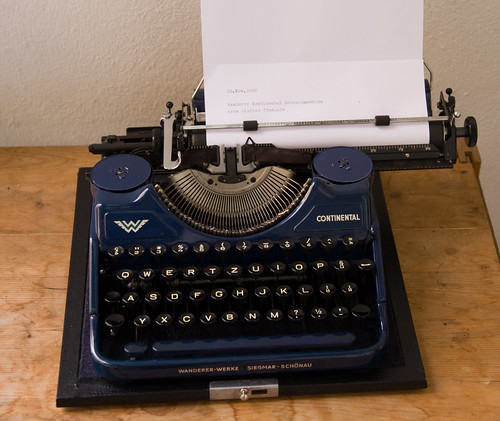
Wir haben dieses abschliessende Stück unserer Schreibmaschinensammlung im Nov.2008 um CHF 100 in Basel erstanden. Es ist eine tragbare Schreibmaschine Continental der Wanderer-Werke, Farbe dunkelblau, Seriennummer 356.320, schweizerischer Tastatur, in sehr gutem Zustand, komplett mit Koffer, Reinigungsbürsten, Schlüssel für das Kassettenschloss, und einem Originaletikett als Anhänger auf dem Koffer. Einzig die Anleitung fehlt.
Die Wandererwerke, gegründet Ende des 19. Jahrhunderts in Siegmar-Schönau, heute ein Stadtteil von Chemnitz (Sachsen), produzierten Fahrräder, Motorräder, Autos, aber auch Büromaschinen. Die Firma existiert nach einer wechselvollen Geschichte nach 1945 heute noch, als Finanzholding ohne eigenen Geschäftsbetrieb mit Sitz in Augsburg (siehe homepage www.wanderer.de).
"1903 nimmt man die Serienproduktion von Schreibmaschinen [...] auf. Mit den Schreibmaschinen hat man es anfangs nicht leicht, denn hier existieren vielfältige Patente amerikanischer Unternehmen, die den Markt auch in Deutschland beherrschen. Also beisst man in den sauren Apfel und entwickelt eine völlig neue Schreibmaschine. Heraus kommt die weltberühmte "Continental". Dies ist die erste Schreibmaschine, die sichtbar schreibt und Typenhebel besitzt. Die "Continental"-Schreibmaschine gilt als die "vollkommenste der Neuzeit". Darauf hält Wanderer nun sechzig Patente." (source: Die Wanderer Werke A.-G. vorm. Winklhofer & Jaenicke, auf: http://www.historisches-chemnitz.de/altchemnitz/industrie/wanderer/wanderer.html)
Wanderer Schreibmaschinen hatten also einen ausgezeichneten Ruf. Tragbare Modelle (Klein-Continental, auf englisch Continental portable) wurden von 1929 bis 1948 produziert. (source: http://www.tw-db.com/indexde.htm). 1933 kam das Model »34«, dann »35«, »50« und 1938 die »100« auf den Markt (source: C.Hamann, http://public.tfh-berlin.de/~hamann/typwrtr/w50.html).
Unser Exemplar ist eine Klein-Continental 50 od. 100. Mit der Seriennummer R 356.320 dürfte sie laut Tabelle in der Schreibmaschinen Seriennummern Datenbank 1941 od. 1942 gebaut worden sein.
Besonderheit ist die schweizerische Tastaturbelegung. Die Tastatur umfasst alle für deutsch notwendigen Umlaute, und auch die im französischen benötigten Akzente. Die Tastaturbelegung entspricht nicht genau der heutigen Schweizer Computertastatur, alle Einzeltasten sind jedoch vorhanden. Der am Koffer befestigte Originalzettel weist "Tastatur 020" aus.
Farbbänder scheinen noch lieferbar zu sein.
Suscribirse a:
Entradas (Atom)